What is Non-surgical Facelift?
What is a non-surgical facelift, what does it correct and what does it not?
Non-surgical facelift is not a single procedure but the general name for various methods aimed at refreshing the face without surgery. Under this heading are focused ultrasound (HIFU) and radiofrequency applications that heat the tissue under the skin to stimulate collagen renewal, limited lifting with absorbable threads, volume-supporting fillers and Botox that soften expression lines. Each targets a different problem of the face; therefore the source of the complaint must be identified first.
Knowing what non-surgical methods do not correct is also important to set realistic expectations. Excess skin, pronounced jowling and prominent neck bands cannot be resolved by non-surgical methods; excess eyelid skin and puffiness are also not within the scope of these methods. In such cases facelift, neck lift or blepharoplasty is considered. The term non-surgical does not mean risk-free or that no downtime will be required.
Which names correspond to which methods?
Many of the names used for non-surgical facelift are different device, product or package names for a few core method groups. Since the same method can be presented under different names in different places, it helps to know the underlying method before comparing offers. The table below groups commonly heard names; differences may exist between devices, products and settings.
| Heard name | Method group | What it targets |
|---|---|---|
| HIFU, ultrasound facelift | Energy-based: focused ultrasound | Gradual tightening in mild laxity |
| Skin tightening with radiofrequency | Energy-based: non-needle radiofrequency | Skin tightness |
| Microneedling, RF microneedling | Energy-based: needle radiofrequency | Skin tightness, skin texture and scars |
| Laser lifting, subdermal laser | Energy-based: laser | Limited tightening by heating under the skin with a fine laser fiber |
| French lift, thread lifts | Thread lift: barbed threads | Limited elevation of cheeks and jawline |
| Spider web aesthetic | Thread application: smooth threads | Skin tightening; limited lifting effect |
| Liquid facelift, focal lifting | Injections: fillers, biostimulators, Botox | Volume loss and expression lines |
| Mesotherapy, skin-rejuvenation injections | Injections: skin quality | Skin hydration and glow; does not provide tightening |
This table is not a service list. Regardless of the name used, what matters is whether the method addresses your specific problem; at the consultation it will be explained which group the recommended procedure belongs to and why it was chosen.
Which method for which finding?
In non-surgical facelift, the method is chosen based on the degree of laxity and the source of the complaint, not by the device or package name. Laxity, volume loss, expression lines and skin surface are different problems and often coexist. The table below summarizes the general relationship between examination findings and commonly considered approaches; the personal plan is determined at the consultation.
| Finding | Commonly considered approach | Note |
|---|---|---|
| Mild laxity, slight loss of skin tightness | Focused ultrasound or radiofrequency | Change is gradual, becomes clear in 3–6 months |
| Mild laxity with reduced skin quality | RF microneedling | Usually multiple sessions |
| Mild–moderate sagging of cheeks and jawline | Thread lift | Effect is limited and temporary; does not remove excess skin |
| Volume loss in cheeks and temples | Filler or biostimulator | Does not lift sagging tissue |
| Expression lines that deepen with movement | Botox | Effect mostly lasts 3–4 months |
| Pronounced sagging, excess skin, neck bands | Facelift or neck lift | Surgical evaluation required |
How are methods planned together?
The most common approach in non-surgical facelift is to use methods that target different issues stepwise and in combination. For example, an energy-based application for skin tightness, fillers for volume loss and Botox for expression lines can be included in the same plan; fractional laser for skin surface and scars can be added in a separate session. The order of applications is important: energy-based procedures are often done before fillers or on a separate day. Discussing multiple methods does not mean all are required; at the consultation it will be explained which target each recommendation addresses and what would change if a method is not performed.
When are non-surgical methods not enough?
Non-surgical facelift is often insufficient when excess skin becomes prominent, jowls descend below the jawline or prominent neck bands form. In this stage, repeated thread lifts or energy sessions may not achieve the expected result and can mean more procedures, time and cumulative downtime. Op. Dr. Hasan Büyükdoğan evaluates during the consultation whether surgery may be more appropriate in addition to non-surgical options; the decision is entirely yours.
What is different in men and in people with prior procedures?
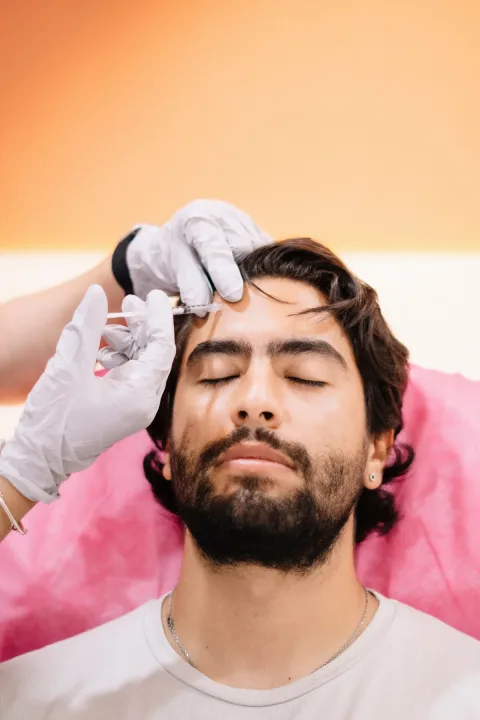
In men, non-surgical facelift is planned with different settings because of thicker skin and stronger facial muscles. Settings for energy-based applications and dosage/points for Botox are adjusted accordingly; in fillers and thread lifts, the goal is a more angular jawline and cheek contour rather than a rounded cheek fullness. In people who previously had threads, fillers or device treatments, the type, date and location of prior procedures change the plan: residual threads or fillers of unknown content can affect the placement and settings of new treatments. Bringing records and old photos of prior procedures to the consultation helps avoid unnecessary repetition.
How to compare non-surgical facelift offers?
When comparing non-surgical facelift offers, look not only at the total price but at why a method is recommended, what the offer includes and how long the effect is expected to last. Under the same name you may be offered a single-session device application or a plan that includes several methods. A treatment that needs repeating every few months cannot be compared only by the price of a single session with a treatment that lasts longer. When requesting an offer, asking the following questions helps:
- Which method or methods will be performed, which group do they belong to and why are they recommended?
- How many sessions will be required, and what are the intervals between sessions?
- If filler is planned, what is the product name and amount; for threads, the type and number of threads; for energy-based treatments, which areas will be treated?
- If there is a package or campaign, which areas and how many sessions does it cover, and is this stated in writing?
- How long is the effect expected to last, and how many repeat sessions might be needed over time?
- Who will perform the procedure; are follow-ups and repeat treatments included if needed?
- What targets of mine cannot be achieved with this method?
Cosmetic non-surgical facelift applications are not covered by SGK.
If you are coming from another city or abroad
Those coming from other cities for non-surgical facelift can usually return on the day of the procedure or the next day for most methods. Op. Dr. Hasan Büyükdoğan's clinic is on Bağdat Caddesi in Kadıköy on the Asian side of Istanbul. This applies to focused ultrasound, radiofrequency, Botox and fillers; for thread lifts it is recommended to stay in Istanbul for a few days for early follow-up. For multi-session applications the visit schedule is planned together in advance. Photographs can be shared securely for preliminary assessment; however, the degree of laxity becomes clear on face-to-face examination. Consultations may be conducted in Turkish, English or German.
What the procedure can address
Not every patient receives the same treatment; the points below may be considered together or separately, depending on the person:
- 01Mild blurring starting at the jawline and slight sagging at the jowl edge
- 02Mild descent of the cheeks and midface
- 03Mild laxity under the chin and in the neck
- 04Decrease in skin tightness and quality
- 05Tired appearance due to volume loss in the cheeks and temples
- 06Forehead and periorbital lines that deepen with facial movement
Who may be a candidate?
Who may be a candidate?
Non-surgical facelift is considered for people with mild to moderate laxity, no significant excess skin, and those who do not want surgery or are not suitable for it. These methods tend to produce more meaningful changes for many people in their 30s to 50s while skin elasticity is still preserved; however, the decision is based on findings rather than age. Two people of the same age may differ: one may achieve adequate results with an energy-based application while the other may require surgery for meaningful change. Suitable candidates know the result is limited and temporary, accept repeat treatments when needed, and have realistic expectations.
Who may not be suitable?
- Pronounced sagging, excess skin or prominent neck bands (surgery may be more appropriate)
- Pregnancy or breastfeeding
- Active infection, open wound or active cold sore in the treatment area
- Metal implants in the treatment area or implanted electronic devices (further evaluation for energy-based methods)
- Uncontrolled chronic illnesses or conditions impairing wound healing
- Use of anticoagulants or bleeding disorders (further evaluation for thread lifts and injections)
- Unrealistic expectation expecting surgical results from a single procedure
Non-surgical methods do not remove excess skin and do not produce the same result as a surgical facelift. The aim is limited tightening and rejuvenation.
The doctor's examination approach
The examination looks beyond appearance to the person's overall anatomy and expectations. Key points assessed:
- Degree and location of sagging
- Skin thickness and elasticity
- Volume loss in cheeks and temples
- Lines due to muscle movement
- Jowl edge and submental area
- Texture, pigmentation and fine lines
- Previous filler, thread and device procedures
- Desired change and acceptable timeframe
The process
The non-surgical facelift plan is prepared individually after evaluating the face from the front, side and in motion; standard photographs are taken for comparison. It is determined whether the complaint stems from laxity, volume loss, muscle movement or skin surface and for each the recommended method, number of sessions, limits of expected change, duration of effect and recovery time are discussed clearly. If surgery is more appropriate, this is also stated clearly.
-
1
Consultation and photographs
Laxity, volume, expression and skin surface are assessed separately; previous procedures are discussed.
-
2
Personalized plan
Method or combination of methods, order of application, number of sessions and limits of expected change are determined.
-
3
Preparation
Medications and supplements are reviewed; treatment area is cleaned and topical numbing cream or local anesthesia is applied.
-
4
Procedure
Usually lasts 30–60 minutes depending on the chosen method and area; duration increases if multiple methods are performed the same day.
-
5
Post-procedure
Instructions on swelling, sensitivity and care are given; warning signs are explained.
-
6
Follow-ups
Response is monitored with planned follow-ups; the need for an additional session or complementary treatment is assessed.
Technique and medical approach
The method depends on the patient; no single technique suits everyone. Main points considered:
| Approach | Description |
|---|---|
| Focused Ultrasound (HIFU) | It focuses ultrasound energy at specific depths under the skin to heat the tissue and stimulate collagen renewal. It does not require an incision and is mostly applied in a single session; change develops gradually, becoming clear in 3–6 months, and the effect usually lasts 1–2 years. |
| Radiofrequency and RF Microneedling | Aims to tighten the skin and improve skin quality by heating with radiofrequency energy. Microneedle applications, commonly known as RF microneedling, also affect skin texture and scars; usually multiple sessions are planned weeks apart. Like other energy-based applications, the effect mostly lasts 1–2 years. |
| Thread Lift (barbed threads and spider web) | Absorbable threads placed under the skin provide limited lifting of tissues in the cheeks and jawline. Barbed threads lift tissue, while smooth threads known as the spider web mainly target skin tightening. Performed under local anesthesia; does not remove excess skin and the effect usually lasts 12–18 months. |
| Fillers, Biostimulators and Liquid Facelift | Support volume loss in cheeks and temples; support in the cheek can indirectly improve the lower face. Applications combining filler, biostimulator and Botox are also called liquid facelift. They do not lift sagging tissue; effects of hyaluronic acid fillers mostly last 6–12 months, and biostimulators may last longer. |
| Botox | Softens expression lines in the forehead, between the brows and around the eyes, and in appropriate candidates can soften neck bands. Effect usually lasts 3–4 months; does not correct tissue sagging. |
Preparing for the procedure
The points below are general information and do not replace personal medical instructions. Your own preparation is set at the examination.
Recovery
-
Procedure day
Day of procedure
Energy-based applications cause mild redness, swelling and sensitivity; most people return to daily life quickly. Thread lifts cause more noticeable tightness, swelling and bruising.
-
Days 1–7
First week
Swelling and sensitivity decrease. After thread lifts avoid wide mouth opening, facial massage and intense exercise; return to social life is typically within 1 week.
-
Weeks 2–6
Early weeks
Tissues settle after thread lifts. For multi-session treatments subsequent sessions are performed weeks apart.
-
Months 3–6
Months
In energy-based applications tightening becomes more noticeable as collagen renews and the result clarifies.
-
Following months and years
Long term
Effect decreases over time depending on the method: Botox mostly 3–4 months, hyaluronic acid fillers 6–12 months, thread lifts 12–18 months, energy-based applications 1–2 years. Repeat treatments or alternative approaches are assessed at consultation.
After non-surgical facelift you are more likely to feel sensitivity, tightness and mild swelling than pain; recovery varies by method. If you experience increasing pain, redness and fever, thread exposure through the skin, blistering or burn scarring, contact the team without waiting for the scheduled visit. After filler, whitening of the skin, color changes or changes in vision, or after Botox difficulty swallowing or breathing require urgent assessment.
Results and realistic expectations
Results in non-surgical facelift are seen at different times depending on the method: changes from fillers and thread lifts are noticeable immediately, Botox begins to take effect within days, and energy-based applications develop tightening gradually and become clear in 3–6 months. Achieved changes are limited compared with surgery and are not permanent; effects typically last about 3–4 months for Botox, 6–12 months for hyaluronic acid fillers, 12–18 months for thread lifts and 1–2 years for energy-based applications. Duration varies with skin type, weight changes, sun exposure and smoking. Expected results in pronounced sagging can only be achieved surgically.
Risks and limitations
Risks of non-surgical facelift vary with the chosen method and are explained separately before the procedure. Important risks include burns and pigmentation changes with energy-based applications, feeling of the thread or skin depression with thread lifts, and the rare but serious risk of vascular occlusion with fillers. Non-surgical does not mean risk-free; a physician who knows the method and appropriate settings reduces risks.
- Redness, swelling, bruising and sensitivity
- Burns, blistering or pigmentation changes with energy-based applications
- Temporary numbness or altered sensation
- Rare fat loss or contour irregularity with RF microneedling
- Feeling of thread, skin depression, temporary difficulty opening mouth, thread extrusion or infection with thread lifts
- Vascular occlusion from filler and very rarely vision loss
- Asymmetry or unsatisfactory result
Alternative and complementary options
In some cases other methods may be considered. Each has its own limits and is not right for everyone:
| Method | Description |
|---|---|
| 1Facelift | In pronounced sagging of the cheeks, jawline and neck it repositions tissues together with the underlying support layer and removes excess skin; aims for a longer-lasting result than non-surgical methods. |
| 2Neck Lift | Surgically corrects laxity under the chin and prominent neck bands. |
| 3Fractional Laser | Considered for skin surface, fine lines and scar appearance; tightening effect is limited. |
| 4Blepharoplasty | Surgically corrects excess eyelid skin and puffiness; non-surgical methods do not remove this excess. |